Why Businesses Need a Modern Credit Decision Engine for Risk Control

Introduction
In today’s fast-changing financial environment, businesses are exposed to higher levels of credit risk than ever before. Whether it is a bank, NBFC, fintech company, or even a B2B enterprise offering trade credit, the ability to assess and control risk determines long-term stability and profitability.
Traditional credit assessment methods—manual reviews, static credit scores, and fragmented data sources—are no longer sufficient. They are slow, inconsistent, and often fail to capture real-time financial behavior.
This is where a modern Credit Decision Engine (CDE) becomes essential. It brings automation, intelligence, and real-time analytics into credit decision-making, enabling organizations to manage risk more effectively and scale lending or credit operations confidently.
This article explores in detail why businesses need a modern credit decision engine for risk control and how it is transforming credit management globally.
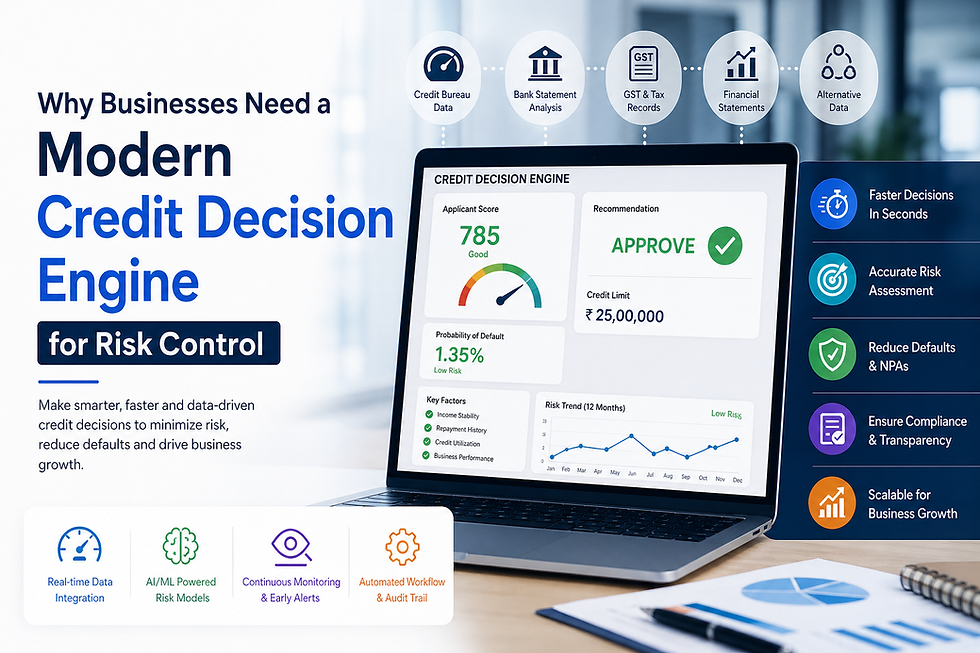
A Credit Decision Engine is a technology-driven system that automates credit evaluation, approval, and monitoring processes using data, rules, and algorithms.
Instead of relying on manual underwriting, a CDE integrates multiple data sources such as:
Credit bureau data
Financial statements
Bank transaction history
GST and tax filings
Behavioral and alternative data
Internal repayment history
It then applies predefined rules, machine learning models, and risk logic to generate fast and consistent credit decisions.
In simple terms, it acts as a digital brain for credit underwriting and risk control.
The Growing Need for Strong Risk Control
Before understanding the importance of a credit decision engine, it is essential to recognize why risk control has become more complex.
1. Increasing Credit Volatility
Global economic uncertainties, inflation, and market disruptions have made borrower behavior unpredictable. Businesses need systems that can react quickly to changes in creditworthiness.
2. Explosion of Data
Companies now have access to massive amounts of financial and non-financial data. Without automation, this data becomes overwhelming and underutilized.
3. Faster Lending Expectations
Customers and businesses expect instant approvals. Manual underwriting cannot keep up with modern speed requirements.
4. Rising Default Risks
Delayed identification of risky borrowers leads to higher NPAs (Non-Performing Assets) and financial losses.
These challenges make modern risk control systems not just useful—but necessary.
How a Modern Credit Decision Engine Works
A Credit Decision Engine typically operates through a structured workflow:
1. Data Collection
It gathers structured and unstructured data from multiple sources such as credit bureaus, bank APIs, accounting systems, and external databases.
2. Data Processing and Normalization
The system cleans and standardizes data to ensure consistency for analysis.
3. Risk Rule Application
Predefined credit policies and rules are applied. For example:
Minimum credit score threshold
Debt-to-income ratio limits
Industry risk filters
4. Machine Learning Scoring
Advanced systems use AI/ML models to predict default probability based on historical patterns.
5. Decision Output
The engine generates outcomes such as:
Approve
Reject
Refer for manual review
Approve with conditions
6. Continuous Monitoring
Modern systems do not stop at approval—they continuously monitor borrower risk post-disbursement.
Key Reasons Businesses Need a Modern Credit Decision Engine
1. Faster and Real-Time Decision Making
Speed is one of the biggest advantages of a Credit Decision Engine.
Traditional underwriting can take days or even weeks. A modern system reduces this to seconds or minutes.
This helps businesses:
Approve loans faster
Improve customer experience
Reduce operational delays
Scale lending volume efficiently
In competitive markets, speed often determines who wins the customer.
2. Improved Accuracy in Risk Assessment
Manual credit evaluation is prone to human bias and inconsistency.
A Credit Decision Engine eliminates these issues by:
Using data-driven models
Applying standardized rules
Reducing subjective judgment
This leads to more accurate predictions of borrower behavior and default risk.
3. Reduced Non-Performing Assets (NPAs)
One of the biggest challenges in lending is managing NPAs.
A modern CDE helps reduce NPAs by:
Identifying high-risk borrowers early
Flagging suspicious financial behavior
Adjusting credit limits dynamically
Monitoring repayment patterns continuously
Early risk detection prevents future financial losses.
4. Enhanced Compliance and Regulatory Control
Financial institutions must comply with strict regulatory frameworks.
A Credit Decision Engine ensures:
Transparent decision-making
Audit trails of all credit decisions
Standardized underwriting policies
Reduced regulatory risk
This makes compliance easier and more efficient.
5. Better Use of Alternative Data
Traditional credit scoring relies heavily on bureau data. However, many borrowers—especially SMEs and new businesses—lack strong credit histories.
A modern CDE incorporates alternative data such as:
GST returns
Bank statement analysis
E-commerce transactions
Utility payments
Supply chain behavior
This leads to more inclusive lending and better risk evaluation.
6. Scalability for Growing Businesses
As businesses grow, manual credit processes become a bottleneck.
A Credit Decision Engine allows organizations to:
Handle thousands of applications simultaneously
Scale lending operations without increasing manpower
Maintain consistent credit quality
This scalability is crucial for fintechs and NBFCs.
7. Real-Time Risk Monitoring
Risk does not end after loan approval.
Modern systems continuously track borrower behavior and financial health. They can:
Detect early warning signals
Trigger alerts for delayed payments
Adjust credit exposure dynamically
This proactive approach strengthens long-term portfolio health.
8. Improved Customer Experience
Customers today expect fast and seamless credit experiences.
A Credit Decision Engine improves experience by:
Eliminating long approval cycles
Offering instant eligibility checks
Providing transparent decisions
A smoother credit journey increases customer trust and retention.
9. Cost Efficiency
Automating credit decision-making reduces dependency on manual underwriting teams.
Businesses benefit from:
Lower operational costs
Reduced paperwork
Fewer errors and rework
Over time, this significantly improves profitability.
Role of AI and Machine Learning in Credit Decision Engines
Modern Credit Decision Engines are powered by Artificial Intelligence and Machine Learning.
AI Capabilities:
Pattern recognition in borrower behavior
Fraud detection
Predictive risk scoring
Automated decision optimization
Machine Learning Benefits:
Continuously improves accuracy over time
Learns from historical defaults and repayments
Adapts to changing economic conditions
This makes the system smarter with every transaction.
Real-World Use Cases
1. Banking Sector
Banks use credit decision engines for retail and corporate loan approvals, reducing processing time and improving risk management.
2. NBFCs
NBFCs rely on CDEs to evaluate small businesses and unsecured loans with better accuracy.
3. Fintech Companies
Fintech platforms use them for instant loan approvals and digital lending.
4. Trade Credit and Supply Chain Finance
Companies use CDEs to assess supplier and buyer risk before extending credit.
Challenges Without a Credit Decision Engine
Businesses relying on traditional systems often face:
Delayed loan approvals
High default rates
Inconsistent credit decisions
Limited scalability
Poor risk visibility
Inefficient manual workflows
These challenges directly impact financial performance and growth.
The Future of Credit Decision Engines
The future of credit decision-making is fully automated, predictive, and intelligent.
Key trends include:
AI-driven credit scoring models
Integration with real-time financial APIs
Blockchain-based verification systems
Hyper-personalized credit policies
Predictive risk forecasting
Credit Decision Engines will evolve into fully autonomous risk management systems.
Conclusion
A modern Credit Decision Engine is no longer a luxury—it is a necessity for any business dealing with credit exposure. It brings together speed, accuracy, automation, and intelligence to transform how credit risk is managed.
From reducing NPAs to improving customer experience and ensuring compliance, the benefits are significant and long-term.
In an era where financial decisions must be fast, data-driven, and accurate, adopting a Credit Decision Engine is one of the most effective steps businesses can take to strengthen risk control and achieve sustainable growth.
FAQs on Credit Decision Engine
1. What is a Credit Decision Engine?
A Credit Decision Engine is an automated system that evaluates credit applications using data, predefined rules, and analytics. It helps businesses make faster, more accurate, and consistent lending decisions.
2. How does a Credit Decision Engine improve risk control?
It improves risk control by analyzing multiple data sources, identifying high-risk applicants early, applying consistent credit rules, and continuously monitoring borrower behavior after approval.
3. What data is used in a Credit Decision Engine?
It uses a combination of:
Credit bureau reports
Financial statements
Bank transaction data
GST and tax records
Alternative data like utility payments or digital transactions
Internal repayment history
4. Can a Credit Decision Engine reduce loan defaults?
Yes. By using predictive analytics and real-time monitoring, it helps detect risky borrowers early and reduces the chances of non-performing assets (NPAs).
5. Is a Credit Decision Engine only useful for banks?
No. It is widely used by NBFCs, fintech companies, lending platforms, and even businesses offering trade credit or supply chain finance.
6. How fast are decisions made using a Credit Decision Engine?
Decisions can be made in seconds or minutes, depending on data availability and system configuration, compared to hours or days in traditional underwriting.
7. Does it replace human credit analysts?
Not completely. It automates routine decisions, while complex or high-value cases can still be reviewed by human analysts for final approval.
8. How does AI improve a Credit Decision Engine?
AI enhances accuracy by identifying patterns, predicting default risk, detecting fraud, and continuously improving decision models based on new data.
9. Is a Credit Decision Engine customizable?
Yes. Businesses can set their own credit policies, risk rules, approval criteria, and scoring models based on industry needs and risk appetite.
10. What is the future of Credit Decision Engines?
The future includes fully AI-driven systems, real-time financial data integration, predictive risk analytics, and fully automated lending ecosystems.


Comments